
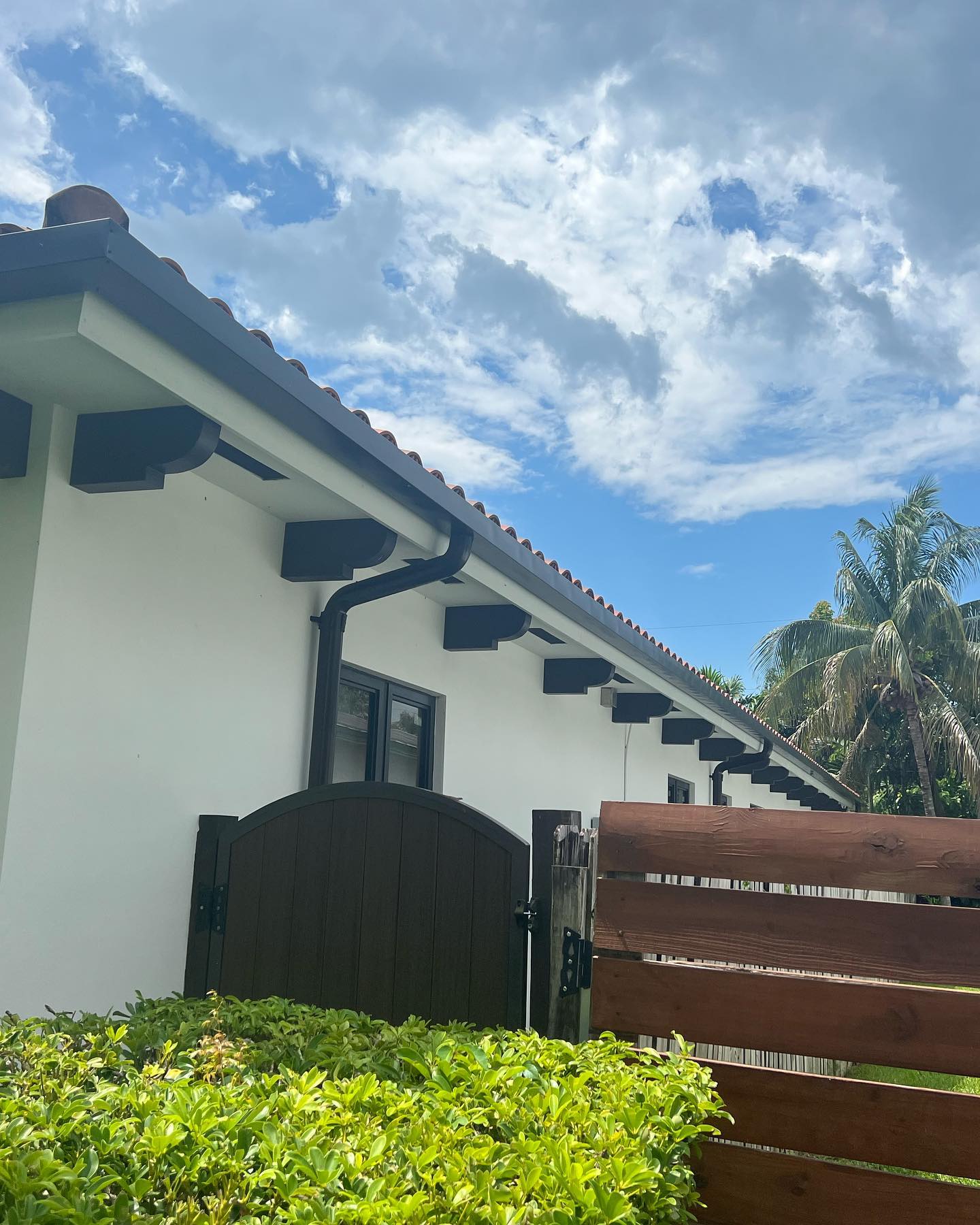
Most gutter failures in Cape Coral start at a seam. Sectional gutters are joined every few feet, and every joint is a place where caulk dries out, salt air corrodes the metal, and water finds a way through. In a tropical downpour, those weak points overflow and dump water against your fascia and foundation.
Then hurricane season arrives. Wind loads pull at every connector, and a system that was already leaking starts pulling away from the roofline. Now you are not just patching a gutter. You are repairing rot in wood you cannot see until it is too late.
That is the case for seamless gutters in Cape Coral, FL. We fabricate a single continuous run on site, cut to your exact roofline, so there are no field joints to fail. If you want it scoped to your home, get a free no-pressure estimate or learn more about our gutter work across Cape Coral.
What seamless means and why it matters
A seamless gutter is one continuous length of aluminum, formed on site, with no joints along the run. The only connection points are the corners and the downspout outlets. Everything between is a single piece of metal.
That matters most in Southwest Florida. Here you face a triple threat: torrential rain, hurricane winds, and corrosive salt air. Sectional gutters give all three something to attack. Seamless runs do not. Fewer parts means fewer places for water, wind, and salt to do damage. If your current gutters already leak at the joints, our gutter repair team can tell you whether to patch or replace.
Fewer joints, fewer leak points
Every seam is a future leak. Sectional gutters rely on sealant and connectors that flex with thermal expansion all summer, then dry, crack, and let water seep behind the gutter.
Seamless installation removes that risk along the run. With no field joints, water has nowhere to escape except where it should: down the downspout. The payoff over the life of the system:
- No caulked seams to dry out and crack in the heat
- No connector clips for salt air to pit and corrode
- Far fewer overflow points during heavy rain
- A cleaner line with less to maintain over the years
On-site fabrication to your exact roofline
We bring the forming machine to your home and roll each gutter run to length on site. That means the gutter is cut to your exact roofline, not pieced together from stock sections.
Before we mount anything, we inspect the fascia. Hidden humidity rot is common here, and a gutter is only as strong as the wood behind it. If the fascia is soft, we address it first, often alongside soffit and fascia work. We hang every run with hidden-hanger systems screwed into solid wood, not spike-and-ferrule, so the gutters hold through wind loads.
5-inch vs 6-inch K-style for tropical downpours
Size is about volume. A 5-inch K-style gutter handles a typical roof well. But Cape Coral does not get typical rain. When a summer storm dumps inches in an hour, a 5-inch gutter on a large or steep roof can overflow at the edge.
For those roofs we recommend 6-inch K-style, paired with oversized 3-inch by 4-inch or dual downspouts to move the water out fast. Quick guidance:
- 5-inch K-style: standard roofs with moderate pitch and shorter runs
- 6-inch K-style: large roof areas, steep pitch, long runs, or heavy valley flow
We size it to your roof during the estimate. Proper downspout installation is half the job in this climate.
Aluminum gauge and salt-air durability
Thin gutters fail fast near the coast. Salt air pits cheap aluminum, and thin metal dents and sags under debris and water weight.
We use .032-gauge aluminum as a minimum for coastal durability. It resists salt-air corrosion better, holds its shape under load, and stands up to thermal expansion through the long Florida summer. Thinner gutters may save a few dollars up front, but they are the ones we end up tearing off after a storm season or two.
Color and curb-appeal options
Seamless gutters carry a baked-on finish in a range of colors, so you can match your fascia, trim, or roof instead of settling for a stripe of mismatched metal across the front of your home.
For homeowners who want a feature rather than just function, we also offer decorative rain chains in place of a standard downspout. They guide water down visibly and add a clean look to entryways and patios. It is a signature option most Cape Coral installers do not market. Ask about it when you call +1 (239) 350-9997.
Stormwater control that protects the home
Gutters are not decoration. They are the line of defense that keeps roof water off your fascia, your walls, and your foundation. When water overflows or pools at the base of the house, you get soil erosion, settling, and moisture intrusion.
A correctly pitched seamless system with properly sized downspouts carries storm volume away and discharges it where it belongs. We set the pitch, place the outlets, and direct discharge so a Cape Coral downpour drains instead of backing up. See how it fits the bigger picture on our services overview.
Maintenance tips for SW Florida
Seamless gutters cut down on maintenance, but they are not maintenance free. Our local debris load is heavy: oak catkins in spring, palm strings, pine needles, and summer pollen all settle in.
A few habits go a long way:
- Clear gutters before hurricane season starts on June 1
- Check downspouts for clogs after heavy storms
- Watch for overflow during rain, a sign of blockage or pitch problems
- Inspect fascia for staining or softness that signals a hidden leak
If climbing a ladder in the heat is not for you, ask about gutter guards to cut the debris load, or schedule routine cleaning and maintenance. We are open 7 days, and the owner often handles estimates personally.