
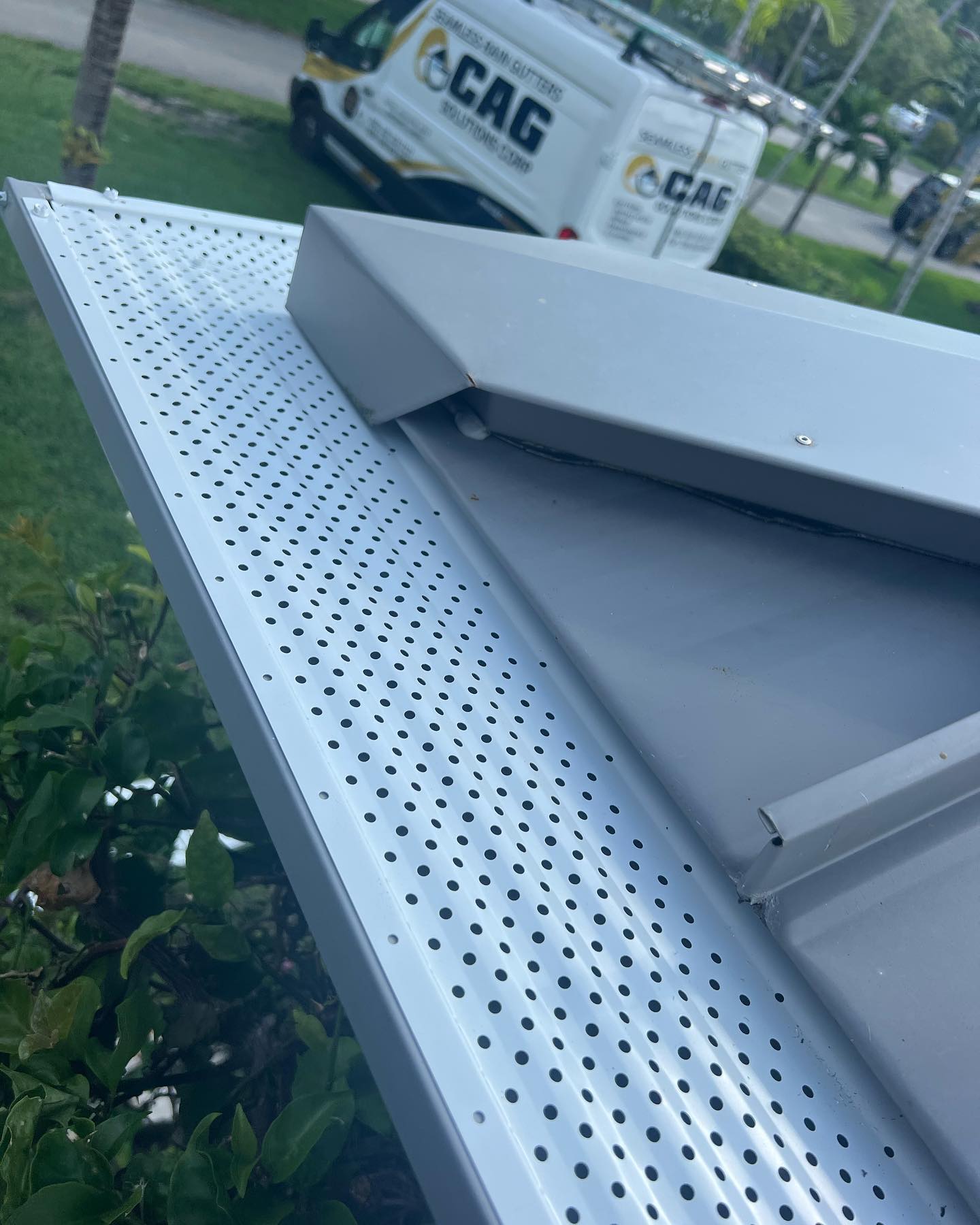
Your Cape Coral gutters fill with oak catkins, palm strings, and pine needles faster than you can climb a ladder. Add summer pollen and the rainy-season debris load, and a clogged channel overflows in the next afternoon downpour. Water sheets behind the gutter and soaks the fascia.
That overflow is the slow killer. Trapped moisture rots fascia, breeds mosquitoes in standing muck, and lets foundation erosion start where nobody's looking. By the time you see the stain, the wood is already soft. We see it on repair calls every season.
Good gutter guards in Cape Coral, FL keep the bulk of that debris out so water actually reaches your downspouts. They are not magic, but the right guard on the right system saves you ladders and saves your fascia. Get a free, no-pressure estimate and we'll tell you straight what your roof needs.
Debris Protection for Florida Vegetation
SW Florida throws more at a gutter than most regions. It is not just leaves. It is fine, stringy, stubborn debris that packs down and dams water.
The usual offenders here:
- Oak catkins in spring that knit together into a mat
- Palm strings and fronds that drape and clog the downspout throat
- Pine needles that slip through cheap screens and weave into a felt
- Summer pollen that turns wet debris into sludge
A guard sized for Florida vegetation sheds the big stuff and lets the fine stuff wash through instead of building a dam. The goal is simple. Keep the channel open so the next storm drains instead of overflows.
Reverse-Curve vs Micro-Mesh: Avoid Cheap Mesh
Not all guards survive Florida. The two serious options are reverse-curve and micro-mesh, and there is a real difference.
Reverse-curve guards use surface tension to pull water around a nose and into the gutter while debris falls off the edge. They handle volume well but can let pine needles and pollen ride the water in.
Micro-mesh uses a fine stainless screen over a frame. A quality mesh blocks the small stuff that defeats everything else here.
Here is the warning. Cheap plastic or wide-hole mesh is worse than no guard at all. Palm strings and pine needles wedge into the holes, the screen stays clogged, and now you cannot rinse it from the ground. You pay to clog yourself. We steer you toward a tight, rigid mesh that holds up to salt air and thermal expansion, not the bargain rolls sold at big-box stores.
Reduced Cleaning Frequency
The honest payoff of guards is fewer trips up the ladder. An open gutter under oak or pine in Cape Coral can need clearing two or three times a year. A good guard cuts that down hard.
You still want a set of eyes on the system, but you trade scooping handfuls of wet sludge for a quick rinse. For homes with steep or two-story rooflines, that is the real value. Less time on a ladder during hurricane season is worth a lot. If you would rather skip the ladder entirely, our gutter cleaning crew handles it on a schedule.
Better Water Flow in Heavy Rain
A guard that chokes flow in a tropical downpour is useless. SW Florida rain comes in volume, fast, and a poorly chosen guard makes water skip right over the lip.
Two things matter for storm flow here:
- A guard rated to pass high-volume rain, not just a drizzle
- Pairing it with oversized 3"x4" or dual downspouts so the water has somewhere to go
A guard does not fix an undersized system. If your gutters overflow now, the guard alone will not save you. We look at pitch, capacity, and downspout sizing together so the whole system moves water during the worst of it.
Guard Installation
Installation is where guards succeed or fail. A guard bolted onto a sagging or wrong-pitched gutter just locks in the problem.
Before we mount anything, we check the system underneath. We confirm the gutter is clean, properly pitched, and screwed to solid fascia with hidden-hanger systems instead of spike-and-ferrule. We inspect the fascia for hidden humidity rot, because no guard helps if the board behind it is soft.
If your gutters are old or undersized, sometimes the right move is a fresh gutter installation with guards designed in from the start. We will tell you which makes sense for your home in Cape Coral.
Guard Replacement
Guards do not last forever in salt air. Plastic ones warp and crack under the UV. Thin screens pit and corrode. Clips loosen as the gutter expands and contracts in the heat.
If your existing guards are buckling, popping off, or letting debris through anyway, replacing them with a rigid, corrosion-resistant guard is cheaper than the fascia repair a failed guard leads to. We pull the old system, inspect what is underneath, and install a guard built to survive the coast.
Guard Maintenance
Guards reduce maintenance. They do not erase it. Fine debris and pollen still settle on top, especially under heavy canopy.
A simple seasonal rinse keeps the surface clear so water flows through. We also check that clips and seams are holding and that nothing has worked loose in wind. Folding this into a gutter maintenance visit before June 1 keeps the system ready when the storms arrive.
Guards Reduce Maintenance, They Don't Eliminate It
We will be straight with you, because we have seen the cleanup. No guard is no-maintenance, no matter what the ads say. Anyone promising you never touch a gutter again is selling, not advising.
What a good guard does is real. It stops the heavy debris, drops your cleaning frequency, and protects your fascia from overflow. It still needs an occasional rinse and a yearly look. That is the honest tradeoff, and it is a good one for most Cape Coral homes. Want our read on whether guards fit your roof? Call for a free estimate and we will give it to you straight.