
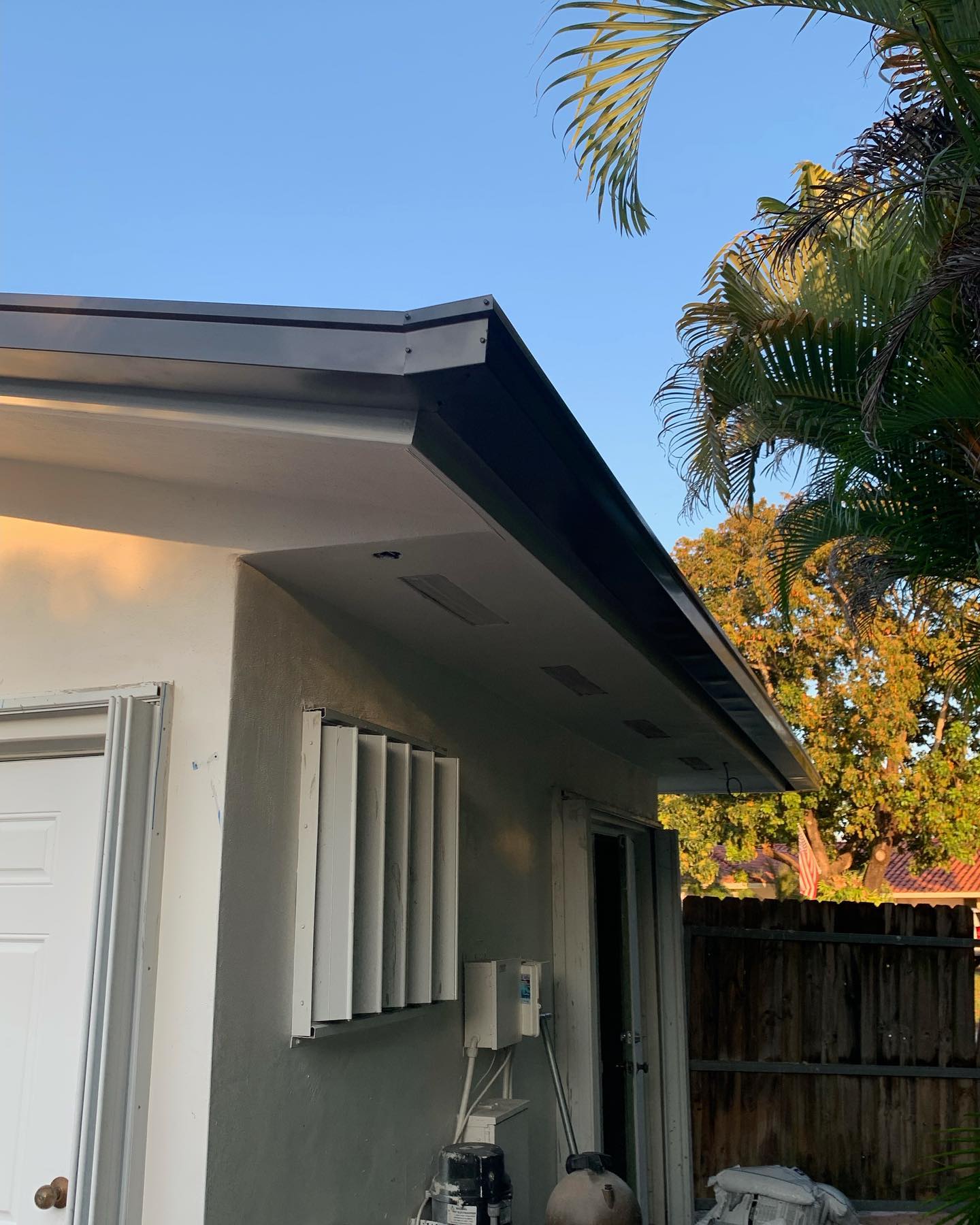
Small gutter problems do not stay small in Southwest Florida. A loose hanger, a hairline joint leak, a downspout that pulled off in the last squall — they all feed water straight to the one place it should never go: behind your gutters and into the fascia.
Then the dry season ends. June arrives, the daily downpours start, and that minor drip becomes overflow sheeting down your siding, pooling at the foundation, and rotting wood you cannot see. Salt air speeds it all along, pitting the metal from the inside out while you are watching the front.
That is why fast, honest gutter repair in Cape Coral, FL matters more here than almost anywhere. We find the real cause, fix it to hold up to wind and salt, and tell you straight when a repair is worth it. Not sure if yours can be saved? Start with a free, no-pressure estimate or read about our full seamless gutter work.
Leaking Gutters
A leak is rarely where you think it is. Water travels along the channel and drips from the lowest point, so the stain on your fascia may be feet away from the actual failure.
The usual culprits in Cape Coral are corroded seams, sealant that has gone brittle in the UV and heat, and pinholes from salt-air pitting. We trace the leak back to its source, clean the metal, and reseal with a product that flexes through our thermal expansion swings instead of cracking by next summer.
Sagging or Pulling Away From the House
A gutter that sags has lost its support. Once it dips, water collects in the low spot, the extra weight pulls harder, and the whole run starts to peel off the fascia.
Sagging usually comes down to one of these:
- Hangers spaced too far apart for our rain volume
- Spike-and-ferrule mounts that worked loose in wind
- Standing water adding weight the run was never pitched to shed
- Soft or rotted fascia that no longer holds a fastener
We re-secure the run, correct the pitch, and add hangers where the spacing was thin. If the fascia is the problem, see the fascia section below.
Loose or Failed Hangers
Hangers are what keep your gutters on the house in a storm. Old spike-and-ferrule systems back out a little more with every gust and every hot-cold expansion cycle until they let go entirely.
We replace failed hardware with hidden-hanger systems that screw into the fascia, not nails driven into wood that swells and shrinks. It is the same approach we use on every new gutter installation — wind-rated from the start.
Overflowing Gutters
If water pours over the front edge during a hard rain, the gutter is not draining as fast as it is filling. Sometimes that is a clog. Sometimes the system was undersized for a SW Florida downpour to begin with.
We check for the real cause before quoting a fix:
- Blockage from oak catkins, palm strings, pine needles, or summer pollen — often solved with a gutter cleaning
- Downspouts too small to move the volume, where oversized 3"x4" or dual outlets are the answer
- Pitch that sends water away from the outlet instead of toward it
Damaged or Disconnected Downspouts
Downspouts take a beating here. Wind rips them off, ladders dent them, and the elbows pop apart at the seams until water dumps right against your foundation.
We reattach, replace crushed sections, and re-secure straps so the line holds in the next blow. Where the original outlet is choking on volume, we talk about downspout upgrades that move tropical rain away from the house fast.
Improper Pitch and Standing Water
Gutters need a slight, deliberate slope toward the downspout. Too flat and water sits. That standing water breeds mosquitoes, adds dead weight that sags the run, and accelerates corrosion from the inside.
If you see a waterline or muck still sitting in the channel a day after rain, the pitch is wrong. We re-hang the affected section to the correct fall so it empties completely and stays lighter through hurricane season.
Separated Joints and End Caps
Every joint and end cap is a place water wants to escape. Sealant fails, sections shift with thermal expansion, and end caps work loose until they leak at the corner.
This is exactly the weakness seamless gutters were built to remove. On repairs we reseal and refasten the joints you have, and where a run is failing at every seam, we will walk you through whether a seamless replacement makes more sense than patching the same spots again.
Storm and Wind Damage
After a tropical system, gutters do not always fail in obvious ways. A run can look fine and still have hangers pulled halfway out, joints knocked loose, or downspouts torn from their straps.
We inspect the whole system, not just the dented section, so a hidden weak point does not become next storm's full tear-off. Book repairs in the dry season, before June 1, while crews and dry days are easy to come by across Cape Coral.
Fascia-Related Failures
Gutters are only as strong as the wood they hang on. When fasteners keep backing out or a run pulls away no matter how often it is re-secured, the fascia underneath is usually the real problem.
Trapped humidity and overflow rot fascia from behind, where you cannot see it. Before we re-mount anything, we check the wood for soft spots and hidden rot. If it is gone, no hanger will hold — and that is when soffit and fascia repair has to come first.
Repair vs. Replace: Honest Guidance
We do not upsell. Plenty of gutters that look rough just need resealing, re-hanging, and a couple of new sections — and we will tell you when that is the case.
We lean toward replacement when the math points there:
- Salt-air pitting has thinned the metal across the run
- You are paying to reseal the same joints season after season
- The gauge is too light to survive another few storm seasons
- The whole system is undersized for the rain it has to carry
Either way, you get a straight answer and a free, no-pressure estimate — often from the owner himself. Reach out and we will tell you what your gutters actually need.