
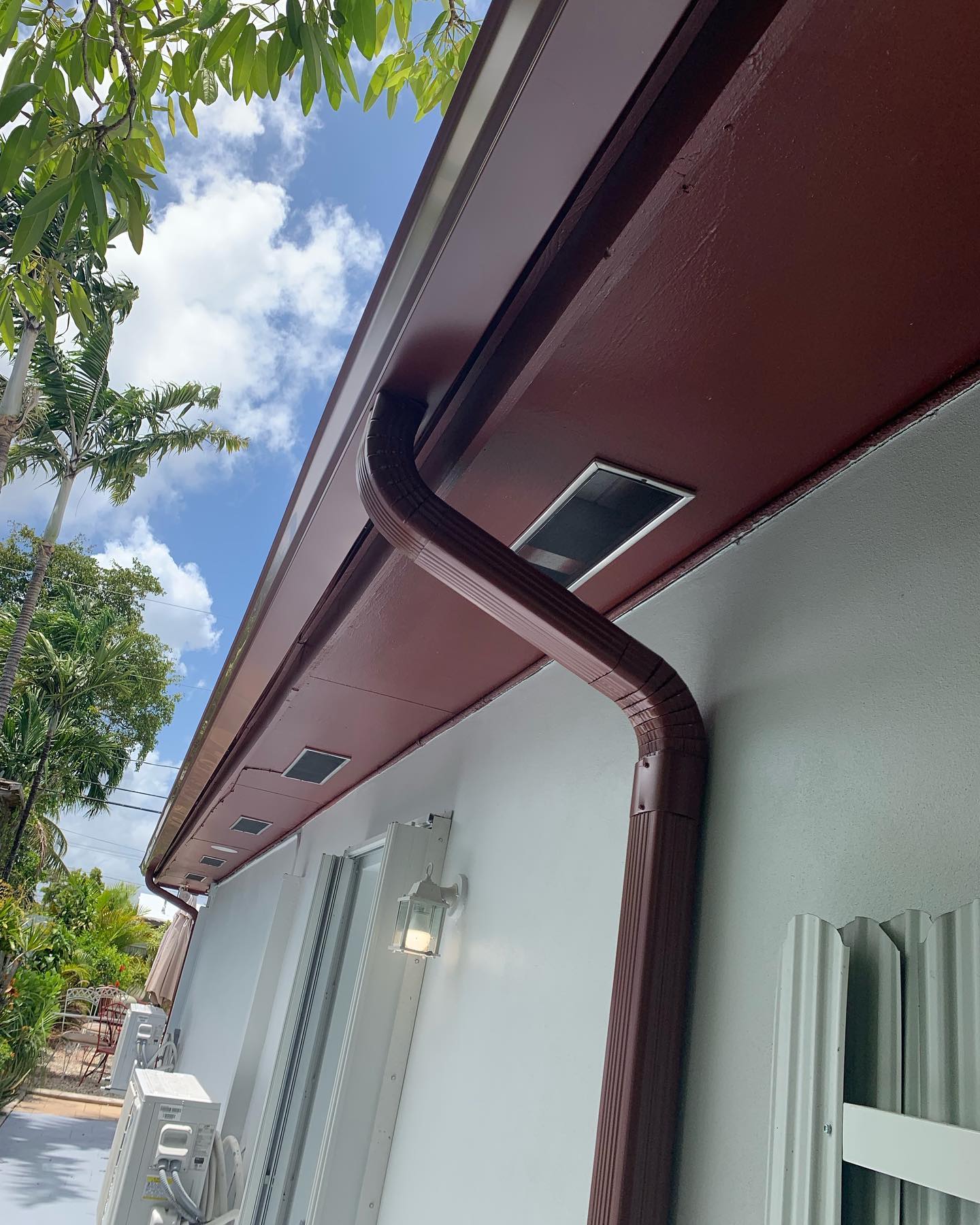
Your gutters catch the rain. Your downspouts decide where it goes. In Cape Coral, that second job is the one that fails homeowners. A storm dumps two inches in twenty minutes, the water sheets off the roof, and an undersized or badly placed downspout dumps it right against the slab, the seawall, or the lanai.
Then the trouble starts. Pooled water erodes the soil under your foundation. It stains the pool deck. It floods the walkway and undermines the driveway edge. Salt air corrodes cheap connectors, and the whole system clogs with palm strings and oak catkins until the next downpour overflows behind the fascia.
That is why downspout installation in Cape Coral, FL is not an afterthought. It is the drainage backbone. CAG Solutions sizes, places, and routes downspouts to move tropical-storm volume away from the things that matter. Pair it with seamless gutters and you get a system built for the way it actually rains here.
Water Redirection Basics
A downspout has one purpose: take everything the gutter collects and put it somewhere safe. In SW Florida, "safe" means away from the slab, away from the seawall, and away from where you walk and entertain.
Placement matters as much as the pipe. A downspout that empties at the base of a wall does nothing but soak the soil there. We map the low points of your lot, find the natural grade, and aim the water downhill toward an area that can absorb it or carry it off.
Get the redirection wrong and the best gutter installation in the world still floods your foundation.
Foundation and Seawall Protection
Cape Coral sits on canals and sandy fill. Concentrated roof runoff against a foundation washes out the supporting soil over time. Against a seawall cap, it does worse, working behind the wall and accelerating failure.
Downspouts are your first line of defense. We discharge them far enough out that the water spreads and drains instead of digging a channel.
- Keep discharge points clear of the slab edge and seawall
- Direct flow with the natural grade, never toward the house
- Use buried lines where surface runoff would pool
Pool Deck and Lanai Drainage
Few things ruin a screened lanai faster than roof water cascading onto the cage and pooling on the pavers. It stains, it breeds algae, and it makes the deck slick.
We place and route downspouts so the runoff bypasses the pool deck entirely. Where the roofline forces water toward the lanai, an extension or buried line carries it past the cage and out to grade. Homeowners booking downspout work alongside a pool enclosure project see the cleanest result.
Driveway and Walkway Runoff
Water crossing a walkway is a slip hazard. Water pooling at a driveway edge undermines the base and cracks the slab from below.
Smart downspout placement keeps both dry. We avoid discharging across paths people use, and we route flow away from paved edges so the base stays solid.
- No discharge points that flood walkways
- Flow directed away from driveway and slab edges
- Extensions or buried lines where the path is unavoidable
Oversized 3x4 and Dual Downspouts for Tropical Volume
Standard residential downspouts are built for gentle rain. SW Florida does not have gentle rain in the summer. A wall of water hits the roof, the gutter fills, and an undersized 2x3 downspout simply cannot drain it fast enough. The gutter overflows behind the fascia.
We size for the worst storm, not the average one. That usually means oversized 3"x4" downspouts, and on long runs or big roof planes, dual downspouts feeding a single gutter line.
- 3"x4" outlets move far more volume than standard 2"x3"
- Dual downspouts split the load on long gutter runs
- Both reduce overflow that rots fascia and soffit
Right-sizing here protects the soffit and fascia from the hidden water damage that overflow causes.
Downspout Extensions
An extension is the simple add-on that finishes the job. It carries the discharge point those last few feet away from the house, past the flower bed, the walkway, or the slab edge.
Above-ground extensions are easy to move and inspect. They are the right call when grading does the rest of the work for you. When they would create a tripping hazard or get in the way of the mower, we go underground instead.
Splash Blocks and Buried Drain Lines for Sandy Soil
Cape Coral's sandy soil drains, but a hard stream of roof water still carves a trench and splashes mud up the wall. A splash block spreads that impact and protects the ground at the outlet.
For bigger volume or longer carries, a buried drain line is the better answer. We run solid pipe underground from the downspout to a discharge point well clear of the foundation, so the surface stays clean and dry.
- Splash blocks for short, simple runs and erosion control at the outlet
- Buried lines to carry high volume past the lanai, deck, or seawall
- Both keep sandy soil from washing out under the slab
Drainage Planning for Your Cape Coral Home
No two lots drain the same. Canal-front, corner lot, slope toward the house, big roof plane over the lanai. Each one changes where the water needs to go.
The owner often walks the property himself, reads the grade, checks the debris load from nearby palms and oaks, and lays out a system that moves storm volume away from everything that matters. We serve homeowners across Cape Coral and the surrounding coast.
Want a plan for your home? Reach out for a free, no-pressure estimate or call +1 (239) 350-9997. We are open 7 days.