Gutter Maintenance Checklist Before Hurricane Season

Hurricane season starts June 1. By then, your gutters are either ready or they are a liability. There is no in-between in Southwest Florida.
Here is the problem most homeowners ignore until it costs them. A clogged or loose gutter does not just overflow in a storm. It dumps thousands of gallons against your foundation, soaks your fascia, and tears loose in 90-mph wind, taking a strip of soffit with it. The fix is cheap. The damage is not. This checklist walks you through exactly what to inspect, clean, and reinforce before the first named storm forms in the Gulf.
Why timing matters in Southwest Florida
Our climate is a triple threat: torrential rain, hurricane-force wind, and corrosive salt air. Each one attacks a different weak point in your gutter system. A system that survives a gentle northern drizzle can fail completely here.
The smart window for this work is the dry season, November through May. The weather is stable, contractors are not buried in emergency calls, and you have time to fix what you find. Wait until July and you are competing with every other panicked homeowner on the Gulf coast.
Book your maintenance and any repairs before June 1. Once the season opens, lead times stretch and you may be stuck riding out a storm with gutters you already know are failing.
Step one: clean out every line of debris
Florida debris is relentless. Oak catkins in spring, palm strings year-round, pine needles, and a heavy coat of summer pollen all settle into your troughs and pack down into a wet mat that water cannot move through.
A clogged gutter in a tropical downpour is worse than no gutter at all. Water backs up over the front edge, runs behind the fascia, and rots the wood from the inside where you cannot see it.
Work through this before storm season:
- Scoop out all leaves, catkins, palm strings, and sediment by hand or with a scoop.
- Flush each run with a hose and watch the water exit the downspout, not the seams.
- Clear the downspouts themselves. Tap the sides and listen for trapped debris.
- Check that water actually drains away from the foundation at the bottom, not into a puddle against the slab.
If you are not comfortable on a ladder, a professional gutter cleaning takes a couple of hours and removes the guesswork. This is also the moment to consider gutter guards if you are tired of doing this twice a year.
Step two: inspect the fascia, hangers, and pitch
Cleaning is the easy part. The inspection is where you catch the failures that actually matter in a storm.
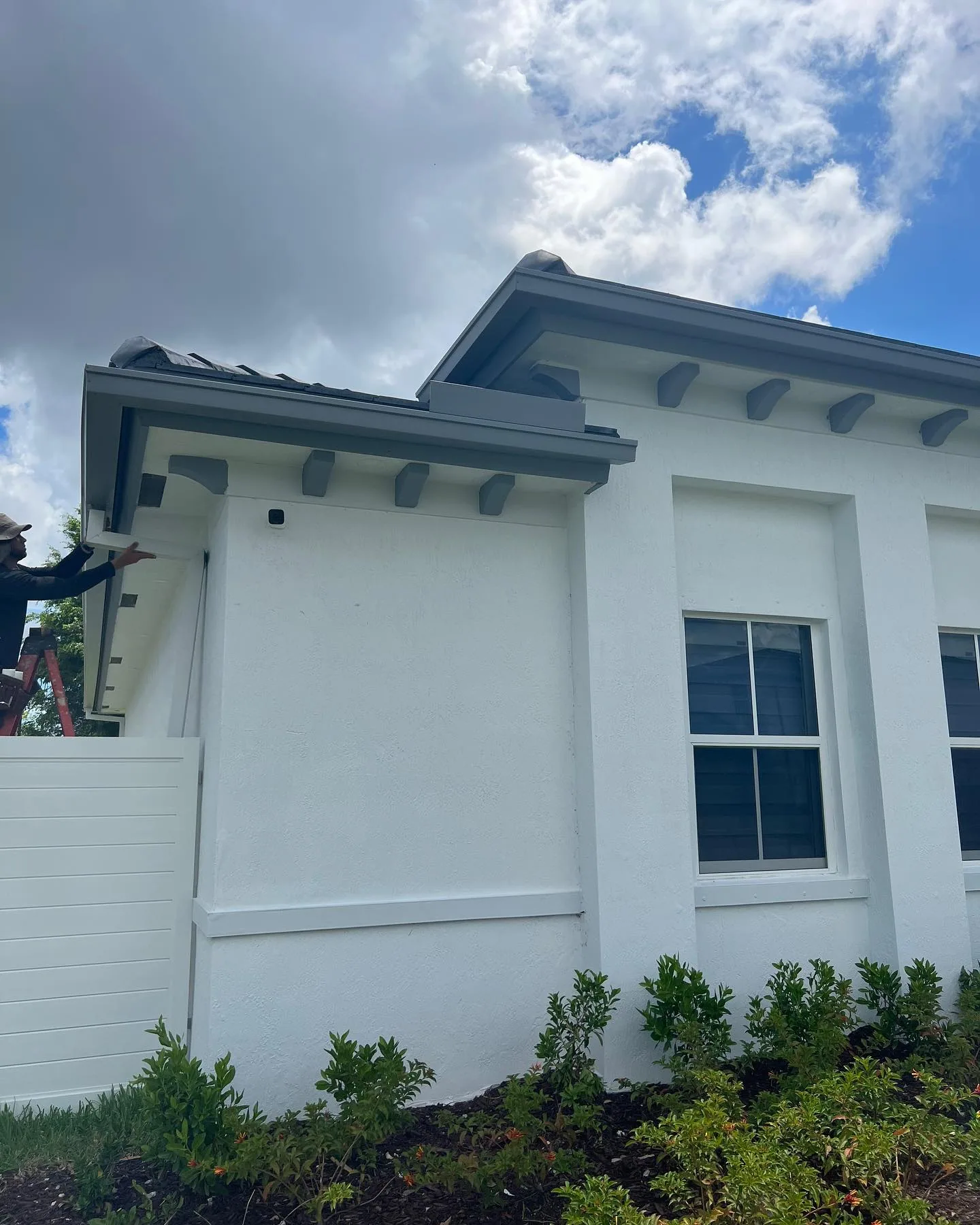
Start with the fascia board behind the gutter. Press on it. If it gives, feels spongy, or shows dark staining, you likely have hidden humidity rot. Mounting a gutter to rotted fascia is mounting it to nothing. It will pull free in the first hard blow. Catch this now and you may only need soffit and fascia repair instead of a full tear-off later.
Then check how the gutter is attached. Old spike-and-ferrule systems work loose over time and have no business on a coastal home. Hidden-hanger systems screwed into the fascia hold far better against wind uplift. If you see nail heads backing out of the front lip, that is a system already failing.
Finally, check the pitch. Gutters need a slight slope toward the downspouts so water keeps moving. Pour water in at the high end and watch it travel. If it pools in the middle, the pitch is off and the trough will overflow long before the rain ever stops.
Step three: check capacity and salt-air corrosion
Two things separate a gutter that handles a Cape Coral downpour from one that overflows in five minutes: gauge and downspout size.
For coastal durability, you want .032-gauge aluminum at minimum. Thinner stock dents in wind-driven debris and pits faster in salt air. If you are near the water in Sanibel or along the river, salt-air pitting is not a maybe, it is a clock running on your system.
Walk the runs and look for:
- White chalky spots or pinhole pitting, the early signs of corrosion.
- Streaks of rust at fasteners or seams, where mixed metals are reacting.
- Sections sized too small for our rainfall volume.
Standard downspouts choke on a tropical downpour. Oversized 3"x4" downspouts, or dual downspouts on long runs, move the volume our storms actually produce. If yours are the narrow residential size, upgrading the downspout capacity is one of the highest-value fixes you can make before a storm.
One more reason seamless matters: seamless gutters have far fewer joints to leak or split under thermal expansion when our metal heats and cools through a summer day.
Step four: secure the extras and clear the surroundings
The details people forget are the ones that become projectiles. Before a storm, walk the perimeter and lock everything down.
- Reattach or remove any loose downspout extensions and splash blocks. A loose extension becomes a missile in high wind.
- Trim back oak and palm branches overhanging the roofline. They drop the debris that clogs you and the limbs that crush your gutters.
- If you run decorative rain chains in place of a downspout, take them down and store them before a named storm. They are beautiful in everyday rain and dangerous in 80-mph gusts.
- Confirm every gutter section feels solid when you tug it. Anything that shifts needs repair now, not after.
How CAG Solutions can help
We have repaired too many homes after cheap installs failed in a tropical storm. We would rather catch the problem in March than rebuild your soffit in September. Our bilingual crew handles pre-season gutter maintenance across Cape Coral, Fort Myers, Punta Gorda, and the surrounding coast, inspecting fascia, hangers, pitch, and capacity so you know exactly where you stand before June 1.
Estimates are free, no pressure, and the owner often does them himself. Call +1 (239) 350-9997 or reach us through our contact page to get on the dry-season schedule before hurricane season fills it.
Need a hand with your gutters?
CAG Solutions provides free, no-pressure estimates across Cape Coral and Southwest Florida.